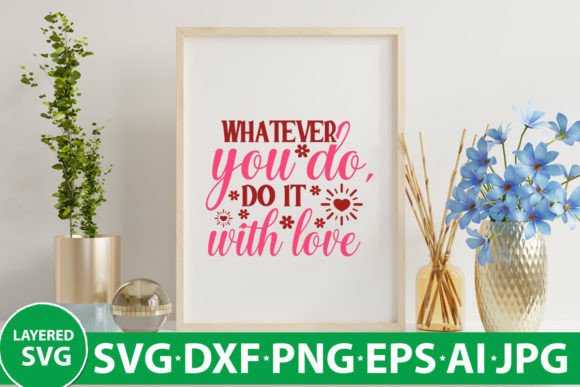
Whatever You Do, Do It with Love
As a designer who spends more time troubleshooting stitch paths than sleeping, I approach every new digital asset with a healthy dose of skepticism. The market is flooded with "ready-to-stitch" files that look beautiful on screen but turn into tangled messes under the needle. That is why I treat my review process as a pre-flight check for your actual business or hobby projects. Today, I am putting Whatever You Do, Do It with Love through its paces to see if it holds up in real-world embroidery scenarios.
First Impressions and Visual Personality
The phrase itself is a classic, carrying an immediate sense of warmth and intention. In the world of handmade goods, emotional resonance is just as important as technical precision. When I first loaded the design files, what struck me was the clean, uncluttered layout. It does not try to be too clever. Instead, it relies on strong typography and a straightforward composition that allows the stitching quality to take center stage.
This kind of simplicity is often harder to execute well than complex pictorial designs. A word-by-word layer structure gives you immense flexibility. You can stack the lines tightly for a bold, impactful block of text, or space them out for a softer, more delicate aesthetic. This versatility makes Whatever You Do, Do It with Love a smart addition to any library of design assets. It feels professional, timeless, and ready to serve as the focal point of a high-quality finished product.
Real-World Application: The Tote Bag Scenario
To truly test this design, I imagined it applied to a common bestseller: a canvas tote bag. This is a staple for Etsy sellers and craft fair vendors alike. The challenge with tote bags is balancing visibility with elegance. If the text is too small, it gets lost in the weave; if it is too dense, it stiffens the fabric and ruins the drape.
With Whatever You Do, Do It with Love, the potential here is significant. Because the file includes multiple formats like SVG, DXF, and AI, you are not limited to just one way of executing the design. For a premium boutique feel, you might use the vector files to cut felt for an applique design, creating a soft, textured contrast against the rough canvas. Alternatively, using the embroidery-specific files (like PES or DST, assuming standard compatibility), you could go for a traditional stitched look.
I envision this working beautifully as a personalized gift. Imagine a mother gifting a tote to her daughter starting college, or a mentor giving it to a mentee. The message reinforces the value of care and effort. For small shop products, this design bridges the gap between inspirational decor and practical utility. It is not just a slogan; it is a statement of values that aligns with the handmade community.
Versatility Across Categories
While the tote bag is a strong candidate, the application range for this graphic extends far beyond bags. Its classification under Crafts and Graphics hints at its adaptability. Here is how it translates across different mediums:
- Sweatshirt Embroidery: The chest area of a crewneck sweatshirt is a prime spot for this quote. The texture of French terry fabric complements the satin stitch or fill stitch options, creating a cozy, tactile experience.
- Baby Embroidery: On onesies or burp cloths, the sentiment resonates deeply with parents. However, this requires careful attention to stitch density to ensure comfort against sensitive skin.
- Holiday Embroidery: During the gifting season, items featuring this phrase make excellent personalized gifts for teachers, neighbors, or family members. It adds a touch of sincerity to holiday baskets.
- Home Decor: Pillow covers or kitchen towels benefit from the domestic warmth of the message. It fits naturally in a farmhouse-style interior.
Technical Considerations and Pitfalls
No design is perfect without proper execution. As an experienced reviewer, I must highlight where Whatever You Do, Do It with Love might face challenges depending on your setup.
First, consider the hoop size. If you attempt to place this on a curved surface like a baseball cap, the lettering may distort if the curve is too aggressive. Flat surfaces like aprons, tea towels, or flat panels on custom apparel will yield the best results. Always map out the placement carefully before anchoring the hoop.
Fabric choice is equally critical. Textured fabrics, such as heavy denim or boucle wool, can obscure fine details. If the design contains thin lines or small serifs, they may disappear into the nap of the material. Conversely, smooth cottons, linens, and poly-blends will show off the clarity of the machine embroidery design. If you are working with dark fabric, ensure your thread colors provide sufficient contrast. A light gray thread on black fabric might lack the punch needed for the message to read clearly.
Another area requiring caution is stitch density. While the visual appeal is high, excessive density can cause puckering, especially on lightweight fabrics like jersey or thin cotton. Use a proper stabilizer—cut-away for stretchy knits and tear-away for wovens—to maintain stability. If the design feels too dense for your project, consider reducing the stitch count or opting for a simpler running stitch outline instead of a full fill.
Testing Before Selling
Before committing to a large production run or listing a new item on your shop, always test the design on scrap fabric. Check the following:
- Thread Color Contrast: Does the text pop? Is it readable from a distance?
- Detail Inspection: Are the corners sharp? Are there any jagged edges in the curves?
- Black and White Mockup: Convert your digital preview to grayscale to check for balance and hierarchy.
- Wash Test: If selling finished goods, wash the sample to ensure the stitches hold up and do not pull or fade.
Final Verdict for Designers and Sellers
Whatever You Do, Do It with Love is a solid, versatile asset for anyone looking to expand their catalog of meaningful handmade products. It avoids the trap of being overly trendy, which means it will remain relevant for years. Its strength lies in its emotional clarity and structural flexibility.
For commercial embroidery businesses, this design offers a low-risk, high-reward opportunity. It appeals to a broad audience, from gift buyers to corporate clients looking for employee appreciation items. For hobbyists, it provides a satisfying project that results in a polished, professional-looking piece.
However, remember that a great file is only half the equation. Your success depends on your ability to pair it with the right materials, stabilizers, and finishing techniques. By treating this design with the respect it deserves—testing thoroughly and choosing appropriate applications—you can create embroidery project outcomes that build customer trust and enhance your brand consistency.
In summary, if you are looking for a reliable, emotionally resonant design that works across multiple product categories, this is a worthy addition to your workflow. Just remember to verify all technical specifications, such as file formats and licensing terms, directly from the source before integrating it into your commercial pipeline.